
 
The
Duluth
Bethel
Society
The Duluth
Bethel
is
one
of
the
oldest
human
services
agencies
in
Northeastern
Minnesota.
It
was
founded
in
1873
when
the
Western
Seamen's
Friend
Society
in
Cleveland
opened
a
branch
in
Duluth.
It
was organized
as a nonprofit corporation on September 6 of the same year. The Bethel was established to "promote temporal and spiritual welfare of seamen and their families and of such as may not have been provided for by regular religious and benevolent societies in the city and vicinity." In the early years it served seamen, miners, lumberjacks, and their families who settled in the frontier port of Duluth. |
The port of Duluth in the late nineteenth century was a place where work and good times could be found. But it also was a place where dreams could be shattered and fortunes lost. The Bethel provided food, shelter, and a helping hand when workers and their families fell on hard times.
First Bethel Building ~
1889
The Bethel preached its message of temperance
first from a dry goods box in the
open air by the docks and then from a
nearby storefront. After local saloon keepers prevented the lease of any other property in the area,
the Bethel purchased its first
property. This first Bethel building was home to a men's reading room, Sunday School, Gospel meetings, cooking school, mothers' meetings, boys' club, sewing school and nursery. The Bethel also hosted an annual Thanksgiving dinner for newsboys.
This first Bethel was located on the corner of Lake Avenue and Sutphin Street, the current site of KBJR News.
Bethel Rescue
Home for Women and Children
On October 15, 1902, the Duluth Bethel opened a rescue home for women and children. The new building in this photo was erected in 1916. Over the years the Bethel cared for hundreds of adults and babies, including a nursery for mentally disabled babies. The building later became known as Hillcrest House and was used as a chemical dependency treatment center for women. It was sold in the 1990s.
New
Bethel
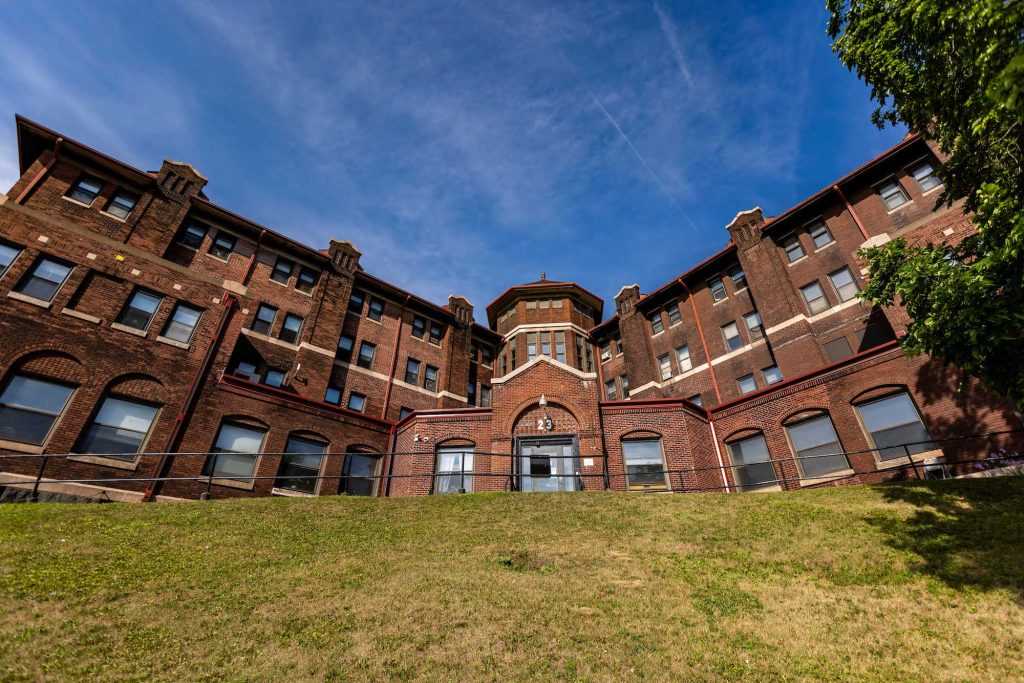
In 1912 the new Bethel was built on the hill overlooking the harbor. A green light on top of the tower was a welcome sign to sailors entering the harbor; it told them the Bethel was a safe place for them to find rest. A 1911 newspaper article stated "the new Bethel will accommodate about 200 people with a public reading room, chapel, fumigator to disinfect clothing and baths."
As part of its spiritual mission
the Bethel conducted regular Sunday
School, summer camps and large
vacation Bible schools. This
photo shows the children from one of
the largest vacation Bible sessions
in the country at the time.
We are still located in this same
historic building.
Rescue Mission
As a rescue mission the Duluth
Bethel had a soup kitchen and dining
room, as well as dormitories for homeless men. This photo,
taken March 7, 1915, shows a common
sight from the time, as 200 homeless men
lay down for
the night.
Bethel Farm ~Lake Venoah
In 1957 Harlow Watkins' family donated 40 acres to the Bethel. The Bethel Farm was developed to provide rehabilitation and meaningful work for chronic alcoholic men. In the early 1960s there was a social shift towards helping mainstream alcoholics rather than the "hard-core" men on the streets. This idea of a rehabilitation center was new so there was no pattern to be followed.
Over time the Bethel Farm was renamed Lake Venoah.
It was sold in the 1990s as the Bethel determined to focus on one location.
Bethel
continues
to serve those in need
The Bethel continued as a Rescue Mission, homeless shelter and Sunday School. Many Duluthians have fond memories of coming to the Bethel for Sunday School. William Grobe and his son Graden after him directed the Bethel for more than 50 years.
In the early 1970s the Bethel shifted to a secular treatment
center. In 1975 it took the
name Port Rehabilitation Center for
Chemical Dependency and provided
residential treatment for
chemically dependent adult men. This is the
longest running of our five current
programs and many people still know
the company and the building as
Port.
Over time other programs were developed in response to local needs. Messabi Work Release opened in 1984 as an alternative for DWI
offenders. The program allowed
clients to retain their jobs and participate in chemical dependency treatment while serving their sentences. A women's program was added in 1989.
The Community Watch Program opened
in 1990 to provide another
alternative to traditional
incarceration. In 1997 the Work Release chemical dependency treatment services became Bethel Outpatient Center while the Work Release Center focused on Community Corrections services . The whole company returned to its original name of Duluth Bethel in the late 1990s.
Since 1873 the Bethel has
maintained the same core mission of
Helping Put Lives Back Together. We look forward to many more years of serving those in need. |